Art 108: Intro to Game Studies Blog
Monday, December 15, 2014
Post 7: Learning Reflection
I learned a lot about games over the semester. From the basics of what defines a game (which it turns out is a bit more difficult than one might expect) to how to make games, be they board games or video games. I learned about game theory, game mechanics, and game design. I learned about iterative design and how it can be used to quickly develop a playable prototype. I also learned that making a board game can be a useful way to help in prototyping for a video game.
What I enjoyed most was learning how to make video games. I am not the most talented programmer, but I know now that I am at least capable of making a simple video game. I know that most popular/complex video games have entire teams of people who work together to make them, but for me, making an entire game mostly by myself, even the ones as simple as I made, is a big accomplishment. When I wasn't completely frustrated with it, I enjoyed learning GameMaker. I am also interested in looking into RenPy and other game making toolkits to see what they offer.
And now, I'm off to go play my current favorite game...
P.S. I recommend you check out this game if you haven't already
Tuesday, November 25, 2014
Post 6: Ingress
I have enjoyed playing Ingress for the last month or so. I am a member of the Enlightenment and have become level 5 after much work for my faction. Since I have been playing Ingress, I now try to leave early so that I can hack and attack portals on my way to class. In my time between classes and on my way back home, I also take time to recharge my portals or try to capture new ones. Basically I spend all my time at school, outside of class, playing Ingress.
My typical path is from the North parking garage to the art building. I try to control or maintain all portals along this path. This usually results in me making 7-8 quick stops along my way.
A glimpse of my usual route. Unfortunately I'm out of town right now and all these portals are controlled by the damn Resistance!
If anybody else
plays Ingress, I'm pretty sure they would recognize what I am doing.
But I wonder what non-players think about my movements. They must think
that I am uncertain about where I am headed; or they must think that I
am texting and that I am unable to walk and text at the same time. I also wonder what people think when they see me going back and forth between portals.
After playing Ingress, I definitely know my way around campus much better. I have ventured around to places that I would not otherwise have gone. Because of Ingress, I walk around a lot more, and I spend time exploring the campus.
Wednesday, November 5, 2014
Post 4: Digital Game Prototype
For my digital game prototype, I created a game named "I Want to Sleep All Day." The concept of the game is too keep your character asleep for as long as possible. You struggle with an alarm clock, a noisy lawn mower, and count sheep which all attempt to reduce your "sleep meter" and wake you up. These challenges happen with an increasing speed and frequency until it is impossible to remain asleep.
the various game screens
My role in making this game was programmer/designer. Justine Pimentel was the artist/producer. Since I am a digital media arts major, I have some basic programming knowledge, but nothing akin to what a Computer Science major would know. I would have liked to have a CS major working on the programming instead of me, but I made it work the best I could. I found the GameMaker interface/language helpful in certain aspects, yet confusing and annoying in others.
Since it was my first time using GameMaker, I had to learn everything as I went along. This resulted in me spending more time programming the game than on game designing. Overall, I happy with how the prototype turned out given my ability. I was able to get the game to ramp up in difficulty/speed at a decent pace, which I think helps to keep the rather simple point-and-click gameplay enjoyable.
||||||MAC version ONLY|||||
sorry Windows users
Monday, October 6, 2014
Post 3: Digital Game Lab
You Have to Burn the Rope
<click image to play>
This game was a little underwhelming, but I suppose that really was the point. I think that the main purpose of this game is to satirize a current trend in video games (giving the player rewards or praise for completing a simple task). This game is actually un-losable (you can't die) and overly instructed. The game tells the player exactly what they need to do, and then gives them a badge for doing it. This is not a fun game, but it is a great piece of satire.
To Build a Better Mousetrap
<click image to play>
This game is a resource management style game. You have to balance the amount of money that you are spending with the amount you are gaining. I like that it doesn't give you any instructions, just visual clues and feedback. It forces you to learn how to play while playing. I think that this game's mechanics are used well to make a statement about capitalism.
Don't Shit Your Pants
<click image to play>
This is a fun little game. It is a text-based "survival" game where you have to figure out how to not shit your pants. I personally enjoy text-based games because they force you to use reasoning skills rather that spacial skills.
This is the Only Level
<click image to play>
Just like the title says, there is only one level in this game, but the level has multiple stages. What makes the game interesting is that with each new stage, the game's mechanics change. One stage you move with the arrow keys, one stage you move with the mouse, one stage you cannot jump, and so on. Even though there is only one level in the entire game, the changing mechanics make repeatedly completing the same task difficult and fun.
Super Puzzle Platformer
<click image to play>
Super Puzzle Platformer is an interesting game that is a mash-up of two types of games. You control your character in a way that is similar to platformer games, while dodging and destroying blocks in a Tetris-style puzzle environment. It's amazing how well these two game styles work together to make a simplistic yet exciting game.
Thursday, October 2, 2014
Post 2: Paper Prototype
Forewarning: Blogger did not save over two hours of work on this post so I am angrily rewriting the majority of this.
Over the course of two weeks, I developed a prototype board game. The game consists of two opposing thieves who compete to steal gold from a bank and return it to their respective get-away vans. Meanwhile, the cop, a non-player character is on his way to the scene of the crime. Players must return to their vans before the cop arrives or else they are arrested and keep none of the gold they have collected.
The game was developed in a series of three development/play sessions.
Session 1
For the first prototyping session, I worked with another classmate to develop the basis for my board game. At the beginning we had no idea what to make, but we knew what we had: poker chips, dice and paper. Contemplating brought us nowhere, so I drew a board with a circle in the center that looked like this
We decided that in the middle there would be gold that you could collect. This would be done by ending your turn on the center tile. Movement based upon a die roll seemed to make sense, so we used that. I reasoned that gold is heavy, and therefor each gold you carried would be a -1 to you roll. This is one core mechanic of the game that remained all the way through to the final iteration of the game. To score gold, it needs to be returned to your side.
Next I wanted to add some player interaction, so I added a stealing mechanic. At this point, the stealing mechanic was rather unrefined and needed a lot of changes. Stealing could occur anywhere on the board, even stealing from opponent's scored pile was allowed. Scoring was successful with a single round of Rock Paper Scissors, and would take all the gold that the opponent was carrying, with no consequences for losing. This made stealing too overpowered and really the only decent strategy.
Session 2
Before play testing my prototype again, I made a few changes. By this time I noticed that the game was basically bank robbery themed, so I called the center tile the bank, and placed a get-away van at the players' starting positions. I realized that the game needed some kind of end point, so I added a non-player character, the cop. The cop would move one space closer to the bank with each player's turn. Once the cop arrived, anyone not safely back in their van would be arrested and lose all their gold.
I wanted to balance the stealing mechanic, so I removed the ability to steal from the opponent's van, and I made a successful steal only worth one gold piece. This helped to make stealing less overpowered, but during the class play session, I noticed that stealing would still occur turn after turn after turn.
Session 3
At this point, I finally got the stealing mechanic right. I made stealing only possible while in the bank, and I created a negative consequence for failed attempts. On a failed steal attempt, the opponent can roll the die and move you in either direction, dismissing the weight of gold you are carrying. I also changed the winning conditions from a single round of Rock Paper Scissors to best of three. With these changes, the mechanic actually became fun and properly balanced.
Then, I realized that there needed to be a way to drop gold in case you ended up carrying too much to move. I added the ability to drop the entire amount of gold you are carrying, which would make it available to the opponent. I set the maximum carry limit at three gold tokens. These changes made new strategies possible. Then I made the bottom four spaces near the van red, meaning it was not safe to leave gold there. If the cop arrived and gold was in a red space, it would leave a trail of evidence to your van, resulting in arrest. Two blue spaces were added closer to the bank, where it would be safe to leave piles of gold, but which were further from your van, and closer to the opponent.
Lastly, with many new strategies possible, the play-time needed to be extended. I changed the cop's movement from once every turn to once every round. To make the end of the game more exciting, I made the cop's movement starting at space 21 be variable. Based on a die roll, he would move either zero spaces or two spaces. To ensure at least one winner at the end, I made the cop arrest only the closest player to him. With these changes, the game actually began to be fun. I'm happy with how it turned out.
Wednesday, September 10, 2014
Post 1: Session Report
On Monday, September 8, myself and three others played a game of Dominion.
My opponents were Player_1 who owned the game, Player_2, and Player_3. The setup of the game took a few minutes because of the large number of cards that were to be used; Ten stacks of ten action (Kingdom) cards, three piles of treasure cards of differing values, and three more stacks of Victory cards representing the land conquered under your dominion.
The Setup
The game was described as a deck-building game where each turn the player plays the top five cards from their hand, from which they can play one action card, and then buy one more card. Certain cards will modify the number of times you can play an action or buy, but the order remains the same; flip, action, buy, end turn. A player wins by having the highest number of Victory cards at the end of the game.
Victory cards
Player_2, Player_3, and myself had never played the game before, so the beginning was slow and confusing. After ten or so rounds us newbies had gotten a handle on the game and it began to run smoothly.
My strategy at first was to mimic Player_1 since he had played before and thus likely knew what he was doing. Once I understood the game a bit better, I focused on building my deck in a way that was a balance of both action cards and treasure cards. Once my deck was strong, I focused entirely on buying Victory cards. I noticed that Player_2 was focused on gathering money (treasure cards) while Player_3 gathered mostly action cards.
The game felt as if it went by quickly once it got going, and it was hard to judge where each player ranked. By the end, I was quite uncertain of which player would win. As we counted victory cards, I realized that I was still counting past Player_1 and Player_3. I ended with a total of 32 victory points and Player_2 was counting in the mid-twenties. As he counted to 30 I became nervous, but then he stopped. I had won by two points! Sweet victory was mine!
My opponents were Player_1 who owned the game, Player_2, and Player_3. The setup of the game took a few minutes because of the large number of cards that were to be used; Ten stacks of ten action (Kingdom) cards, three piles of treasure cards of differing values, and three more stacks of Victory cards representing the land conquered under your dominion.
The game was described as a deck-building game where each turn the player plays the top five cards from their hand, from which they can play one action card, and then buy one more card. Certain cards will modify the number of times you can play an action or buy, but the order remains the same; flip, action, buy, end turn. A player wins by having the highest number of Victory cards at the end of the game.
Victory cards
Player_2, Player_3, and myself had never played the game before, so the beginning was slow and confusing. After ten or so rounds us newbies had gotten a handle on the game and it began to run smoothly.
My strategy at first was to mimic Player_1 since he had played before and thus likely knew what he was doing. Once I understood the game a bit better, I focused on building my deck in a way that was a balance of both action cards and treasure cards. Once my deck was strong, I focused entirely on buying Victory cards. I noticed that Player_2 was focused on gathering money (treasure cards) while Player_3 gathered mostly action cards.
The game felt as if it went by quickly once it got going, and it was hard to judge where each player ranked. By the end, I was quite uncertain of which player would win. As we counted victory cards, I realized that I was still counting past Player_1 and Player_3. I ended with a total of 32 victory points and Player_2 was counting in the mid-twenties. As he counted to 30 I became nervous, but then he stopped. I had won by two points! Sweet victory was mine!
Wednesday, August 27, 2014
Post Zero (Introduction)
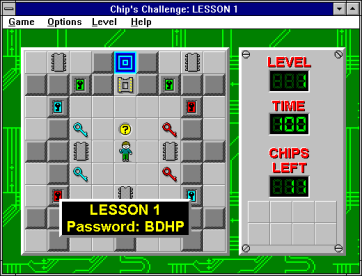
The following will be a brief overview regarding my personal history with games, particularly video games. I have been playing video games for nearly as long as I can recall. My earliest memories of video games include
Chip's Challenge
And this gem right here
SkiFree
That damn abominable snowman was inescapable! I would have kept skiing for eternity if he didn't stop me.
The first gaming console I ever owned was a Super Nintendo, upon which I enjoyed playing the Super Mario games. Around this time, I also recall an Atari console which was stored in an old boot box, which belonged to my parents. There where only a few games that we owned for it, but I remember it distinctly because it was so different from the Nintendo. I was intrigued by its strange qualities, from the feel of it's joystick controller, to the aesthetics of both the games and the console itself.
From then on, I collected a whole slew of gaming consoles. There was the Nintendo 64, a hand-me-down Sega Genesis, the Playstation, the PS2 and PS3, the XBOX 360. Of course, who can forget the various portable, hand-held systems like the Nintendo GameBoy and all its iterations throughout the years. And all this supplemented with a steady stream of desktop computer games when needed.
If I where to estimate the time I've spent playing games, I would guess that at least a third of my life has been spent doing so. I think it's safe to say that gaming has been a large part of my life, and always will be.
And this gem right here
That damn abominable snowman was inescapable! I would have kept skiing for eternity if he didn't stop me.
The first gaming console I ever owned was a Super Nintendo, upon which I enjoyed playing the Super Mario games. Around this time, I also recall an Atari console which was stored in an old boot box, which belonged to my parents. There where only a few games that we owned for it, but I remember it distinctly because it was so different from the Nintendo. I was intrigued by its strange qualities, from the feel of it's joystick controller, to the aesthetics of both the games and the console itself.
From then on, I collected a whole slew of gaming consoles. There was the Nintendo 64, a hand-me-down Sega Genesis, the Playstation, the PS2 and PS3, the XBOX 360. Of course, who can forget the various portable, hand-held systems like the Nintendo GameBoy and all its iterations throughout the years. And all this supplemented with a steady stream of desktop computer games when needed.
If I where to estimate the time I've spent playing games, I would guess that at least a third of my life has been spent doing so. I think it's safe to say that gaming has been a large part of my life, and always will be.
Subscribe to:
Posts (Atom)